The owl as a symbol of wisdom: Ancient origins and modern resonance

The owl's association with wisdom stands as one of humanity's most enduring symbolic relationships, transcending cultures and millennia to remain powerful even in our modern world. From its ancient origins in Mediterranean civilizations to its contemporary use in academic logos and popular culture, the owl continues to represent intellectual pursuit and deep knowledge.
The connection between owls and wisdom finds its most prominent ancient expression in Greek mythology, where the owl served as the sacred companion of Athena, goddess of wisdom and strategic warfare. The Little Owl (Athene noctua), native to Athens, became so closely associated with the city that its image appeared on Athenian coins, creating one of the earliest examples of wildlife on currency. The owl's ability to see in darkness metaphorically represented Athena's capacity to see beyond the obvious – to perceive what others could not. Ancient Egyptian culture also revered the owl, though with a different emphasis. In hieroglyphics, the owl symbol represented the sound "m" and was associated with death and night. This connection to the mysterious realm of darkness, far from diminishing the owl's status, enhanced its reputation as a creature privy to hidden knowledge.
The owl's biological characteristics have significantly contributed to its reputation for wisdom. Its forward-facing eyes, unusual among birds, create an expression that appears contemplative and intelligent to human observers. The owl's ability to rotate its head up to 270 degrees suggests a capacity to see things from multiple perspectives – a key attribute of wisdom. Moreover, the owl's nocturnal nature has long fascinated humans. Its ability to navigate and hunt in darkness symbolizes the power to comprehend what lies beyond the visible world, representing deep understanding and insight.
In contemporary culture, the owl's association with wisdom has evolved but remained remarkably consistent with its ancient meanings. Academic institutions worldwide incorporate owl imagery into their logos and architectural designs, from traditional universities to online learning platforms. The owl has become a universal shorthand for education and knowledge. Popular culture has embraced and reinforced this symbolism. From the wise owl in Winnie the Pooh to Hedwig in Harry Potter, literary owls often serve as intelligent guides or companions. Even in digital communication, owl emoji and imagery frequently appear in educational contexts and intellectual discussions.
While the owl's association with wisdom is particularly strong in Western traditions, other cultures offer fascinating counterpoints. In many Native American traditions, the owl is seen as a powerful spiritual messenger, though not necessarily connected specifically to wisdom. In parts of India, owls represent wisdom but are also associated with Lakshmi, the goddess of prosperity, suggesting a connection between knowledge and material success.
The persistence of the owl as a symbol of wisdom in modern times speaks to humanity's ongoing need for symbols that represent our highest intellectual aspirations. In an era of information overload, the owl's patient, observant nature resonates with our desire for deep understanding rather than mere knowledge accumulation. The owl's traditional associations have also evolved to encompass modern interpretations of wisdom. Beyond mere knowledge, the owl has come to represent emotional intelligence, mindfulness, and the ability to navigate complexity – qualities increasingly valued in contemporary society.
The owl's journey from ancient religious symbol to modern icon of education and wisdom demonstrates the enduring human need for symbols that represent our intellectual and spiritual aspirations. Its continued relevance speaks to both the power of ancient symbolism and our ongoing quest for wisdom in an increasingly complex world. As we face unprecedented challenges in the 21st century, the owl's symbolism reminds us that true wisdom involves not just accumulating information, but developing the ability to see clearly through darkness and complexity. In this way, the ancient symbol continues to offer relevant guidance for modern times.
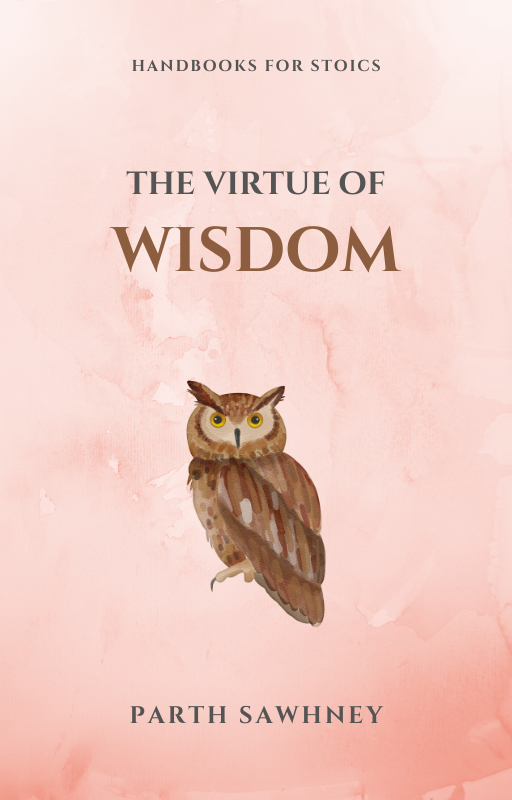
In "The Virtue of Wisdom," the fourth volume of the acclaimed Handbooks for Stoics series, Parth Sawhney delves deep into the cornerstone of Stoic philosophy—practical wisdom. Drawing from ancient wisdom and modern applications, this impactful work illuminates how the pursuit of knowledge transforms not just our understanding, but our very existence.
Parth masterfully bridges the gap between theoretical wisdom and daily practice, offering readers a comprehensive guide to developing phronesis—the practical wisdom that enables sound judgment in an increasingly complex world. Through engaging narratives, practical exercises, and profound insights, he demonstrates how wisdom transcends mere intelligence to become the compass by which we navigate life's challenges.
Inside these pages, readers will discover:
• The distinction between knowledge and wisdom, and why this difference matters
• Ancient Stoic techniques for cultivating practical wisdom in everyday situations
• How to develop discernment in decision-making
• Methods for transforming information into actionable wisdom
• Real-world applications of Stoic wisdom principles in modern contexts
Whether you're a dedicated Stoic practitioner or new to philosophy, this essential volume provides the tools to cultivate true wisdom—not as an abstract concept, but as a living, breathing practice. Continuing the tradition of accessibility and depth that readers have come to expect from the Handbooks for Stoics series, "The Virtue of Wisdom" stands as both a practical manual and a profound meditation on one of Stoicism's most vital teachings.
Transform your understanding into wisdom, and your wisdom into action. Your journey to practical wisdom begins here.
Get your copy today! Learn more here.


